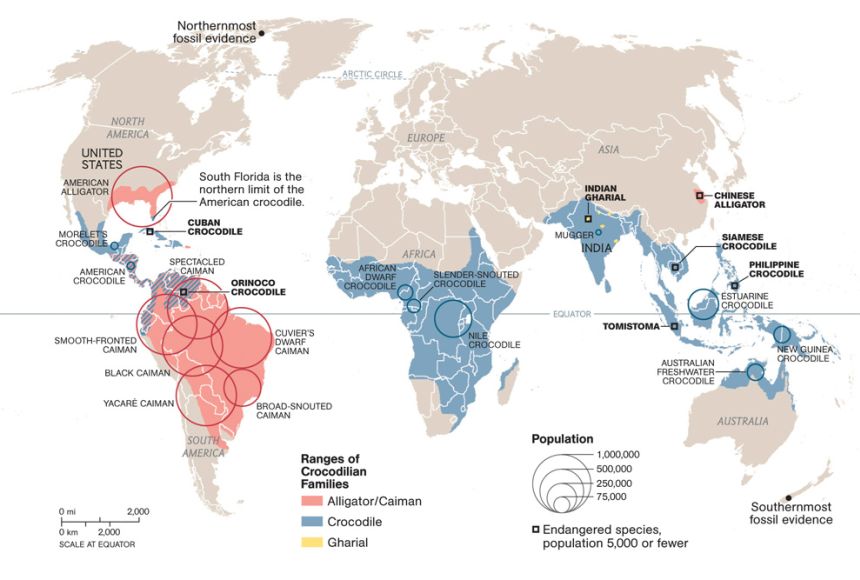
India is home to three main species of crocodiles: the saltwater crocodile, the mugger or marsh crocodile, and the gharial. These reptiles are found in various freshwater and saltwater habitats across the country, and a variety of conservation programs, such as captive breeding and habitat protection, are in place to protect them.
Species of Indian crocodiles
Saltwater Crocodile (Crocodylus porosus): Found in coastal areas, the Saltwater crocodile is primarily located in the Bhitarkanika mangrove system, the Sundarbans, and the Andaman and Nicobar Islands.
Mugger Crocodile (Crocodylus palustris): Also known as the Marsh Crocodile, this is the most common species and is found in a wide range of freshwater habitats like rivers, lakes, and marshes across the Indian subcontinent. They can also be found in coastal lagoons and estuaries.
Gharial (Gavialis gangeticus): A critically endangered species with a long, narrow snout, the Gharial is a fish-eating crocodile that inhabits the major river systems of the Indian subcontinent.
Family – 2 / Genus – 2 / Species – 3 (2+1)
Note: G – Genus / S – Species / IWPA – Indian Wildlife (Protection) Act / IUCN – International Union for Conservation of Nature
The Amur tiger is the largest of the tiger subspecies.
The coat of the Amur tiger is the palest orange of all the tigers and has the fewest stripes. Each tiger’s stripes are unique and act as identifiers for other tigers. It has a scruff of fur around its neck that is more developed than other tigers, which helps protect it from the cold environment in which it lives. They generally live alone, but they do keep in contact with other tigers through scent marking. Another way they communicate is through scrapes on the ground, claw marks, and vocalizations.