

Indian Rock Python

Species
Indian Rock Python
Scientific name
Python molurus
Other names
Indian Python
Local names
Ajgar (Hindi and Marathi); Perumpaampu, Malampaampu (Malayalam)
Family
Pythonidae
Genus
Python
Туре
Python
Toxicity
Non venomous
Habit
Terrestrial, Arboreal/Climber
Population status
Uncommon
Indian Rock Python is iconic and one of the most recognized snakes of Indian Subcontinent. It was described in 1758 by the Father of taxonomy Carl Linnaeus from India in his famous work Systema Naturae. In the 19th century, it was assumed to be widely distributed species with two subspecies under it. But modern molecular studies confirmed that its widely distributed population should be treated as separate species Burmese Python (Python bivittatus). It is endemic to Indian Subcontinent and in every region's folklores, stories, mythology and religious literature etc. it is widely discussed and considered a unique creature due to its massive size and ability to kill mammals. In some parts of its range, it is mistakenly assumed as a snake which can pull its enemy or prey by breathing from a scientifically incorrect distance. Many other similar stories are passed from generation to generation but none of them has any scientific base. In all parts of its range, it is the largest and heaviest snake. Due to its ability to feed on medium-size mammals, it is considered as farmers friend because it consumes a variety of animals from rodents to deer. In many parts of north-west India, it is regularly used in snake charming works. Also, many tribes consume it for edible purpose.
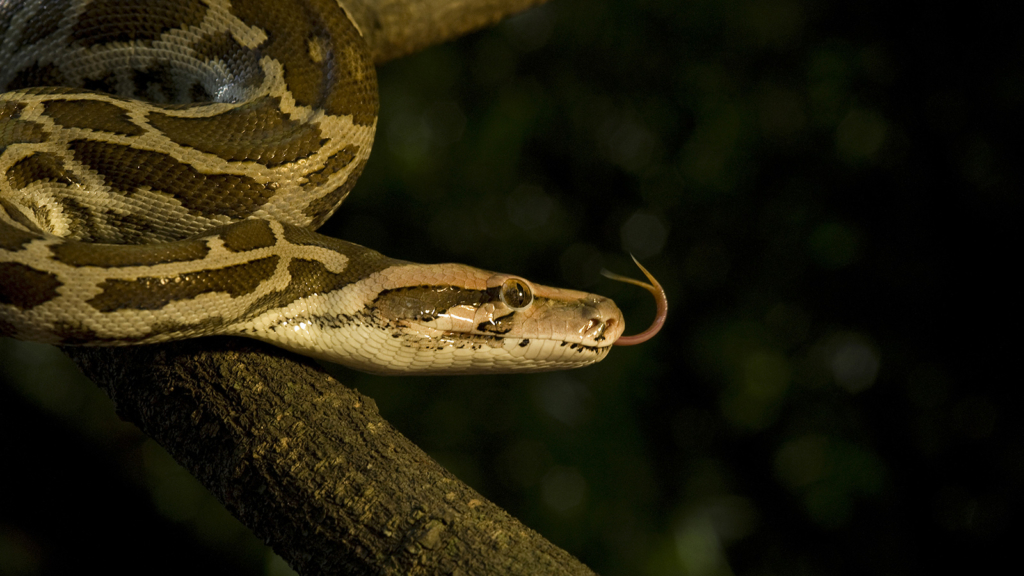
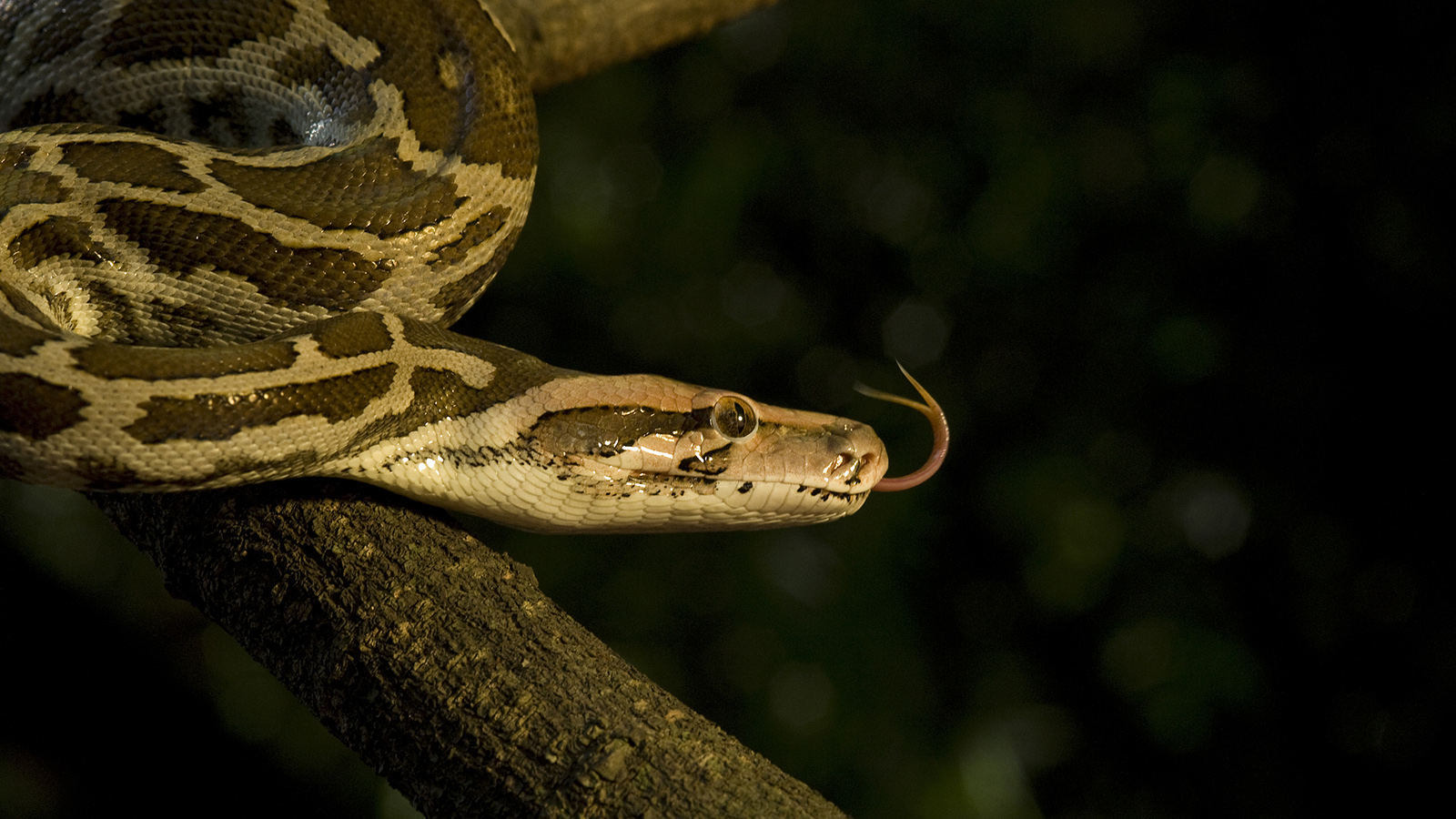
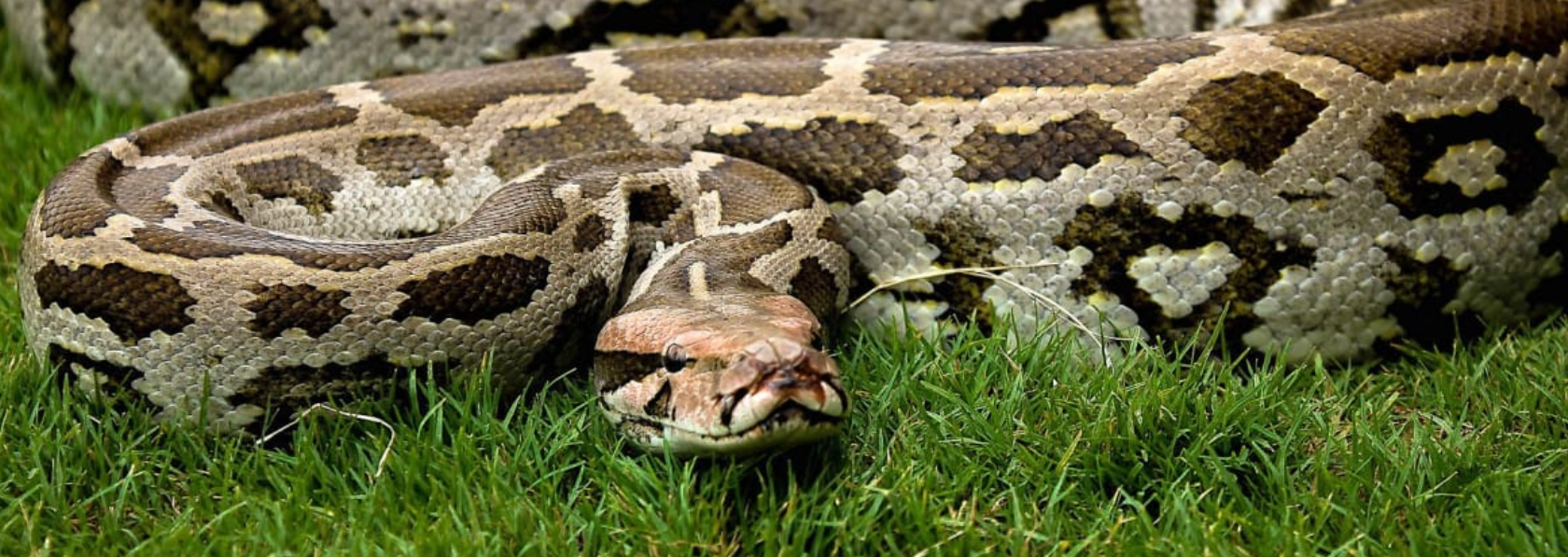
It is a very large-sized and heavy-bodied snake which can grow up to 18ft (540cm) but individuals above 13ft (390cm) are rare. Newborn individuals are about 45-50cm. The body is heavy, thick and covered with glossy smooth scales. Head is flat, distinct from the neck and its colour is pinkish-brown with the faint greyish arrow mark on the top. Eyes are moderate and bear vertically elliptical pupils. The upper body is entirely covered with large, irregular and disconnected dark brown or grey-black blotches over paler or light grey-brown ground colour. The side body region is off-white and marked with much smaller patches. The underside is creamy-white or yellowish with dark patches near the outer edge of the ventral scales. Heat sensing pits are laterally found below the nostrils on the anterior sides of the lips. Both sexes' bear "spur" (thorn-like structure) on each side of anal, which are larger in males. The tail is short, bears prominent and irregular black reticulations over yellow-brown ground colour and clearly looks darker than the rest of the body.
11-13 supralabials, 6th or 7th in contact with eyes; rostral and first two supralabials pitted with the heat-sensing pit. Dorsal scales smooth, in 60-75 rows. Ventrals 253-270; narrow, anal undivided. Subcaudals 58-73; paired.
Indian Rock Python is usually distinct from all the other snakes in subadult and adult stage due to its heavy and large body. However, juveniles are often confused with Russell's viper and Sand Boas.
From Russell's Viper it is different by having the much heavier and larger body (usually 200-400cm vs 120cm), irregular squarish blotches (vs oval blotches in three series), black blotched tail (vs faintly patterned tail), glossy smooth scales (dry looking highly keeled scales).
From Common Sand Boa it is different by having glossy smooth scales (vs dry looking keeled scales), disconnected blotches on upper body (vs mutually connected blotches on upper body), head broader than the neck (vs head not broader than neck), a typical short tail with smooth scales (vs much shorter and thicker tail with highly keeled scales).
Indian Rock Python is a nocturnal snake but it regularly shows activity at day time especially for sun basking in winter months and can forage at day time too. It is usually terrestrial in activity but it climbs well and can take shelter in old trees and tall buildings. It is found in a variety of ecosystems like open and dense forests, rainforests, dry deciduous forests, swamps, mangroves, agricultural lands, well-vegetated urban areas etc. of hills and plains. It chooses mammal mounds, dense vegetation, tree holes, caves, deep cracks, etc. for hiding and prefers activity around water bodies. Its diet consists of a variety of animals which include birds, rodents, small-medium sized mammals (antelopes, deer, jackals, dogs, cats, monkeys, bats etc.). It often raids on livestock farms like poultry farms and animal shelters for food. Ambush predation is its speciality which can be attributed to its camouflaging body patterns which are suitable for dry vegetations and rocks. Its mating occurs during winter to mid-summer months after which the female lavs and incubates a clutch of up to 100 eggs inside caves, mounds, tunnels or tree holes. Hatchlings are seen during pre-monsoon to mid monsoon. Its locomotion is slower than typical snakes but performs well in both swamps and water. Its behaviour is usually inoffensive and its first response is to escape and hide under dense objects. But on provocation, it makes a coil of its body and hisses which sounds like a whistle (somewhat similar to Russell's viper but not that loud) and can strike very fast to induce an injurious and painful bite.
It is widely distributed across the most of the Indian Subcontinent (including Sri Lanka), except north-eastern states where Burmese Python replaces it and also not found in Thar Desert.
Indian Rock Python is a non-venomous snake which can impart a painful bite due to its numerous sharp teeth which tear the victim's skin. But such bites are never fatal and can be handled as ordinary mechanical injuries.
1) Indian Rock Python is one of the largest snakes in the world.
2) It is the largest and heaviest snake in its range.
3) In most of the Indian Subcontinent it is the only representative of the Python family.


Species
Indian Rock Python
Scientific name
Python molurus
Other names
Indian Python
Local names
Ajgar (Hindi and Marathi); Perumpaampu, Malampaampu (Malayalam)
Family
Pythonidae
Genus
Python
Туре
Python
Toxicity
Non venomous
Habit
Terrestrial, Arboreal/Climber
Population status
Uncommon
Indian Rock Python is iconic and one of the most recognized snakes of Indian Subcontinent. It was described in 1758 by the Father of taxonomy Carl Linnaeus from India in his famous work Systema Naturae. In the 19th century, it was assumed to be widely distributed species with two subspecies under it. But modern molecular studies confirmed that its widely distributed population should be treated as separate species Burmese Python (Python bivittatus). It is endemic to Indian Subcontinent and in every region's folklores, stories, mythology and religious literature etc. it is widely discussed and considered a unique creature due to its massive size and ability to kill mammals. In some parts of its range, it is mistakenly assumed as a snake which can pull its enemy or prey by breathing from a scientifically incorrect distance. Many other similar stories are passed from generation to generation but none of them has any scientific base. In all parts of its range, it is the largest and heaviest snake. Due to its ability to feed on medium-size mammals, it is considered as farmers friend because it consumes a variety of animals from rodents to deer. In many parts of north-west India, it is regularly used in snake charming works. Also, many tribes consume it for edible purpose.
2) It is the largest and heaviest snake in its range.
3) In most of the Indian Subcontinent it is the only representative of the Python family.

Payment System

